



Introduction
Concrete is one of the most widely used construction materials in the world. From residential buildings and commercial complexes to bridges, highways, and dams, concrete plays a critical role in ensuring structural stability and durability. However, the quality of concrete must be verified before and during construction to ensure safety and compliance with industry standards.
This is where Concrete Testing Equipment becomes essential. Testing helps engineers, contractors, and quality control professionals evaluate the strength, durability, consistency, and performance of concrete. A reliable Concrete Testing Instrument Manufacturer provides advanced testing solutions that help construction companies maintain quality standards and avoid structural failures.
At Barkat Hitech Engineering, we understand the importance of accurate concrete testing and offer high-quality testing solutions designed to meet industry requirements. In this guide, we will explore the different types of concrete testing machines, their applications, and the standards that govern concrete testing.
1. What Is a Concrete Testing Machine?
A concrete testing machine is a specialized device used to evaluate the physical and mechanical properties of concrete. These machines help determine whether concrete meets the required specifications for a construction project.
The primary purpose of Concrete Testing Equipment is to:
- Measure compressive strength
- Evaluate tensile strength
- Assess workability
- Determine durability
- Verify quality compliance
- Detect material defects
- Improve construction safety
- Ensure long-term structural performance
A trusted Concrete Testing Instrument Manufacturer is Barkat Hitech Engineering, which develops equipment that delivers precise and repeatable testing results for laboratories, construction sites, and quality control facilities.
2. Importance of Concrete Testing in Construction
Concrete Testing Equipment is a vital part of modern construction because it ensures that structures are built using materials that meet specified standards.
2.1 Quality Assurance
Testing confirms that the concrete mix meets project requirements before it is used in construction.
2.2 Structural Safety
Proper testing helps identify weak concrete before it affects the structural integrity of buildings and infrastructure.
2.3 Compliance with Standards
Construction projects must comply with national and international standards. Testing ensures adherence to these regulations.
2.4 Cost Savings
Detecting problems early helps prevent costly repairs, project delays, and material wastage.
2.5 Improved Durability
Testing helps evaluate concrete performance under different environmental and loading conditions.
2.6 Risk Reduction
Reliable Concrete Testing Equipment by Barkat Hitech Engineering minimizes the risk of structural failures and accidents.
3. Types of Concrete Testing Machines
Different Concrete Testing machines are used to evaluate various concrete properties. Each machine serves a specific purpose in quality assessment.
1. Compression Testing Machine (CTM)
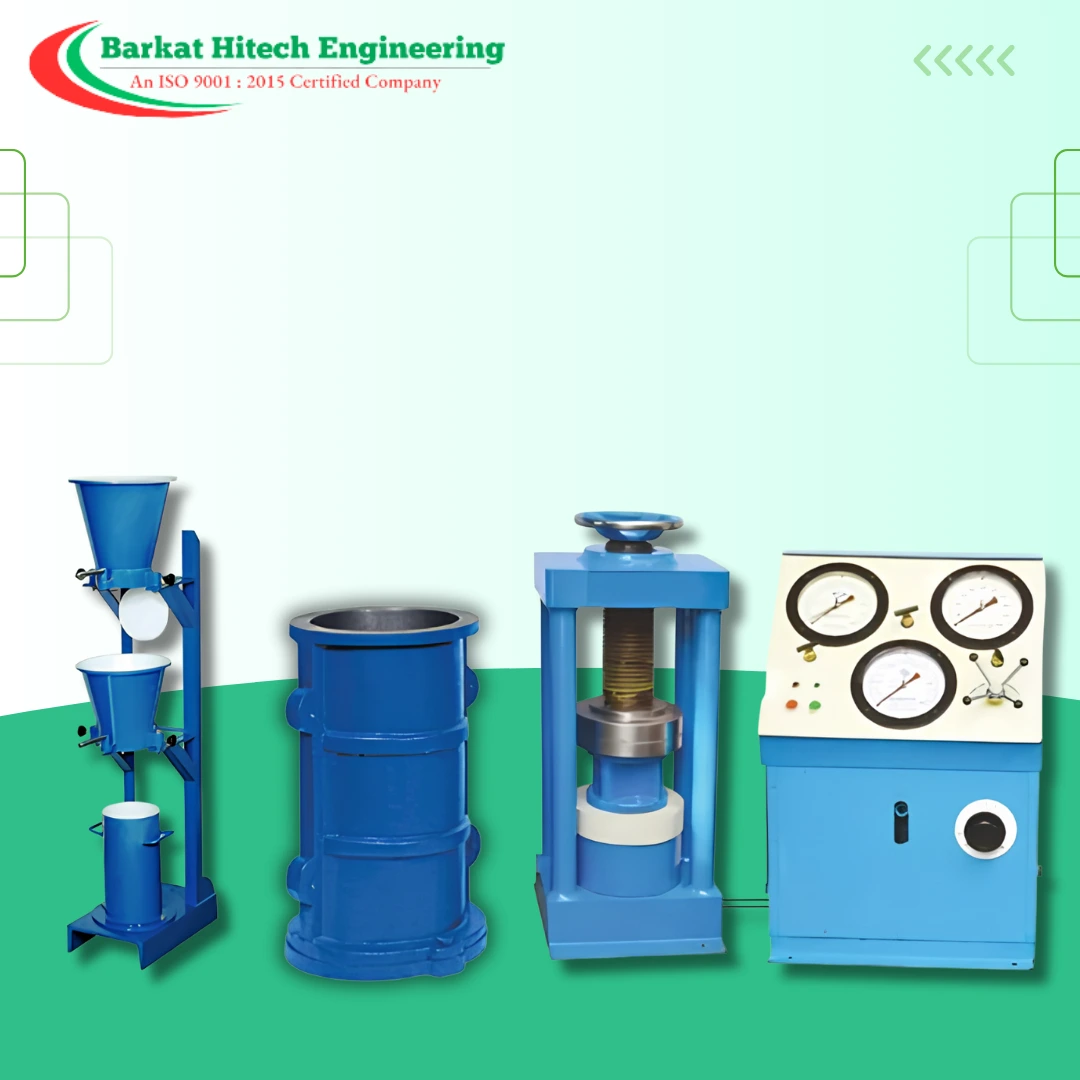
Barkat Hitech Engineering for the Compression Testing Machine is used to measure the compressive strength of concrete. It is considered one of the most important pieces of testing equipment in the construction industry for evaluating the quality, durability, and load-bearing capacity of concrete structures.
Key Features
- High load capacity ranging from 1000 kN to 3000 kN.
- Digital display for accurate test readings.
- Automatic load pacing system.
- Rugged steel construction for long service life.
- Easy specimen positioning mechanism.
Advantages
- Accurate compressive strength measurement.
- Ensures compliance with IS and ASTM standards.
- Reduces human error through automation.
- Suitable for both laboratory and field testing.
Common Applications
- Concrete cube testing.
- Cylinder strength testing.
- Quality control laboratories.
- Infrastructure projects such as bridges and highways.
2. Rebound Hammer Test Equipment
A Rebound Hammer is a widely used non-destructive testing (NDT) instrument that measures the surface hardness of hardened concrete and provides an approximate assessment of its compressive strength, helping engineers evaluate concrete quality quickly and efficiently.
Key Features
- Portable and lightweight design.
- No damage to the structure.
- Instant test results.
- Easy field operation.
- Suitable for existing structures.
Advantages
- Quick assessment of concrete quality.
- Cost-effective testing solution.
- No specimen preparation required.
- Useful for maintenance inspections.
Common Applications
- Building inspections.
- Bridge evaluations.
- Structural health monitoring.
- Renovation projects.
3. Ultrasonic Pulse Velocity (UPV) Tester
A UPV Tester utilizes ultrasonic waves to evaluate the quality of concrete and detect internal defects such as cracks, voids, honeycombing, and other structural irregularities without causing any damage to the structure.
Key Features
- High-frequency pulse transmission.
- Digital data recording.
- Real-time analysis.
- Portable operation.
- Non-destructive testing method.
Advantages
- Detects cracks and voids.
- Evaluates concrete uniformity.
- Improves quality assessment accuracy.
- Suitable for large structures.
Common Applications
- Dams and tunnels.
- Bridges and flyovers.
- Industrial structures.
- Research laboratories.
4. Uses of Concrete Testing Equipment
Barkat Hitech Engineering for Concrete testing machines serves a wide range of applications across the construction and engineering sectors.
4.1 Construction Projects
Testing verifies that concrete used in buildings and infrastructure meets design requirements.
4.2 Road and Highway Development
Concrete pavements require strength and durability testing to ensure long service life.
4.3 Bridge Construction
Testing helps maintain safety and reliability in bridge structures.
4.4 Industrial Facilities
Factories and warehouses require strong concrete floors capable of handling heavy loads.
4.5 Dams and Water Structures
Durability and permeability testing are essential for water-retaining structures.
4.6 Research and Development
Testing equipment supports innovation in concrete materials and construction technologies.
4.7 Quality Control Laboratories
Laboratories use advanced Barkat Hitech Engineering for Concrete Testing Equipment for routine testing and certification.
5. Factors to Consider When Choosing Concrete Testing Equipment
Selecting the right Concrete Testing Equipment is crucial for obtaining accurate results.
5.1 Accuracy
Choose equipment with high precision and repeatability.
5.2 Compliance
Ensure the equipment meets IS, ASTM, BS, or EN standards.
5.3 Durability
Industrial testing environments require rugged and reliable machines.
5.4 Ease of Operation
User-friendly controls improve productivity and reduce operator errors.
5.5 Automation Features
Modern machines offer digital displays, automatic calculations, and data storage.
5.6 Service Support
Reliable technical support and maintenance services are essential.
5.7 Calibration Capability
Regular calibration ensures long-term testing accuracy.
5.8 Application Requirements
Different projects require different testing methods. Choose equipment based on your specific testing needs.
6. Benefits of Concrete Testing Equipment
6.1 Improved Quality Assurance
Regular testing ensures every concrete batch meets required strength and durability standards.
6.2 Enhanced Structural Safety
Testing helps identify weak concrete before construction progresses, reducing failure risks.
6.3 Compliance with Standards
Testing equipment ensures compliance with:
- IS 516
- IS 456
- ASTM C39
- ASTM C805
- BS EN 12390
6.4 Cost Savings
Early detection of quality issues prevents expensive repairs and reconstruction work.
6.5 Increased Project Reliability
Accurate testing improves confidence among contractors, consultants, and project owners.
7. Why Choose Barkat Hitech Engineering?
Barkat Hitech Engineering is committed to delivering reliable and advanced Concrete Testing Equipment for laboratories, construction companies, and engineering organizations.
Our Strengths
- Extensive industry experience
- High-quality manufacturing standards
- Accurate and reliable testing instruments
- Compliance with national and international standards
- Advanced technology integration
- Competitive pricing
- Excellent customer support
- Timely delivery of products
Wide Product Portfolio
- Compression Testing Machines
- Concrete Cube Testing Machines
- Rebound Hammers
- UPV Testers
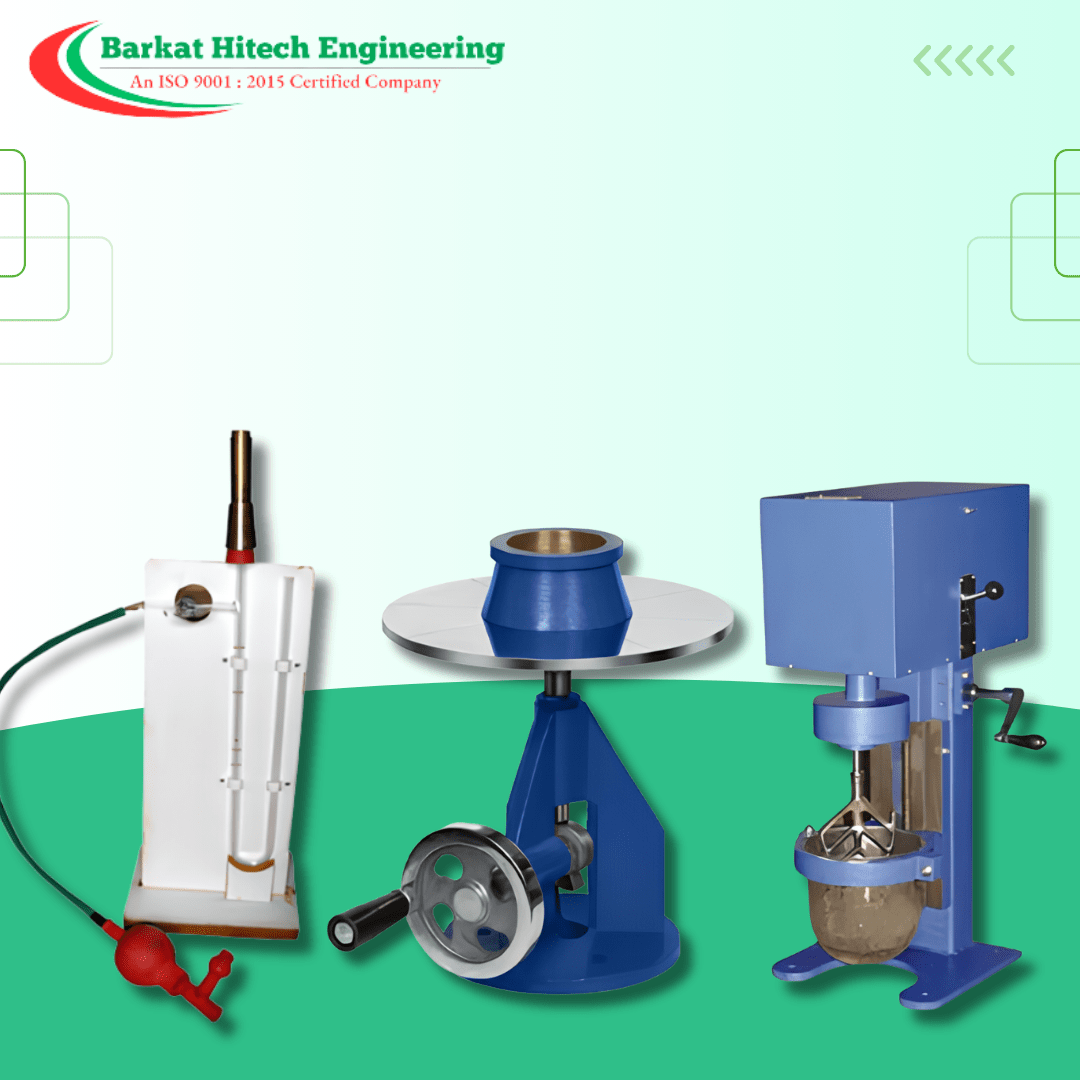
- Slump Test Apparatus
- Vibrating Tables
- Curing Tanks
Competitive Advantages
- Precision-engineered products
- Compliance with international standards
- Reliable after-sales support
- Custom testing solutions
- Timely delivery across India
As a trusted Concrete Testing Instrument Manufacturer by Barkat Hitech Engineering, we focus on helping clients achieve accurate testing, improved quality control, and enhanced construction safety.
Conclusion
Concrete Testing Equipment plays a critical role in ensuring the quality, strength, and durability of construction projects. From compression testing machines and slump test apparatus to ultrasonic pulse velocity testers and permeability testing equipment, each testing instrument serves a unique purpose in evaluating concrete performance.
Choosing the right Concrete Testing Equipment helps construction professionals maintain compliance, improve structural safety, and achieve long-term project success. Working with an experienced Concrete Testing Instrument Manufacturer, such as Barkat Hitech Engineering, ensures access to reliable equipment, technical expertise, and comprehensive support.
As construction standards continue to evolve, investing in advanced testing solutions remains one of the most effective ways to guarantee quality, durability, and safety in every project.
FAQs – Concrete Testing Instrument Manufacturer
1. What is a concrete testing machine?
A concrete testing machine is used to evaluate the strength, quality, and durability of concrete.
2. Why is concrete testing important?
It ensures concrete meets safety, quality, and performance standards for construction projects.
3. What is the most commonly used concrete testing equipment?
The Compression Testing Machine (CTM) is the most commonly used equipment for strength testing.
4. What does a slump test measure?
A slump test measures the workability and consistency of fresh concrete.
5. What is non-destructive concrete testing?
It is a testing method that evaluates concrete quality without damaging the structure.
6. Which standards are used for concrete testing?
Common standards include IS, ASTM, BS, and EN standards.
7. Who uses concrete testing equipment?
Construction companies, laboratories, engineers, contractors, and quality control professionals use it.
8. How do I choose a Concrete Testing Instrument Manufacturer?
Choose a manufacturer based on product quality, accuracy, standards compliance, and after-sales support.