



Introduction
Concrete is one of the most widely used construction materials in the world. From residential buildings and commercial complexes to bridges, highways, and industrial structures, concrete forms the backbone of modern infrastructure. However, the strength and durability of concrete must be verified before it is used in critical construction projects. This is where Concrete Testing Equipment from Barkat Hitech Engineering plays a crucial role.
Among the various testing devices available, the Compression Testing Machine (CTM) is considered one of the most important instruments for evaluating the compressive strength of concrete. Since concrete is primarily designed to withstand compressive loads, measuring its compressive strength is essential for ensuring structural safety, compliance with standards, and long-term performance.
A reliable Compression Testing Machine enables engineers, contractors, quality control laboratories, and construction professionals to accurately assess the strength characteristics of concrete specimens. Choosing the right equipment from a trusted Concrete Testing Instrument Manufacturer is Barkat Hitech Engineering, ensures precise results, operational efficiency, and compliance with industry standards.
In this comprehensive guide, we will explore the importance of compression testing machines, their working principles, applications, benefits, testing procedures, and factors to consider when selecting the best concrete testing equipment.
1. Understanding Concrete Strength Evaluation
Concrete strength evaluation is a critical process that determines whether concrete meets the specified design requirements. The compressive strength of concrete is generally measured after curing periods such as 7, 14, and 28 days.
The strength of concrete depends on several factors, including:
- Water-cement ratio
- Aggregate quality
- Cement type
- Mixing process
- Curing conditions
- Environmental exposure
Testing helps identify variations in concrete quality and ensures that construction materials meet the required standards.
Without proper testing, structures may suffer from:
- Cracking
- Premature deterioration
- Reduced load-bearing capacity
- Structural failures
- Increased maintenance costs
This is why advanced Concrete Testing Equipment is essential for maintaining quality control in construction projects.
2. What is a Compression Testing Machine?
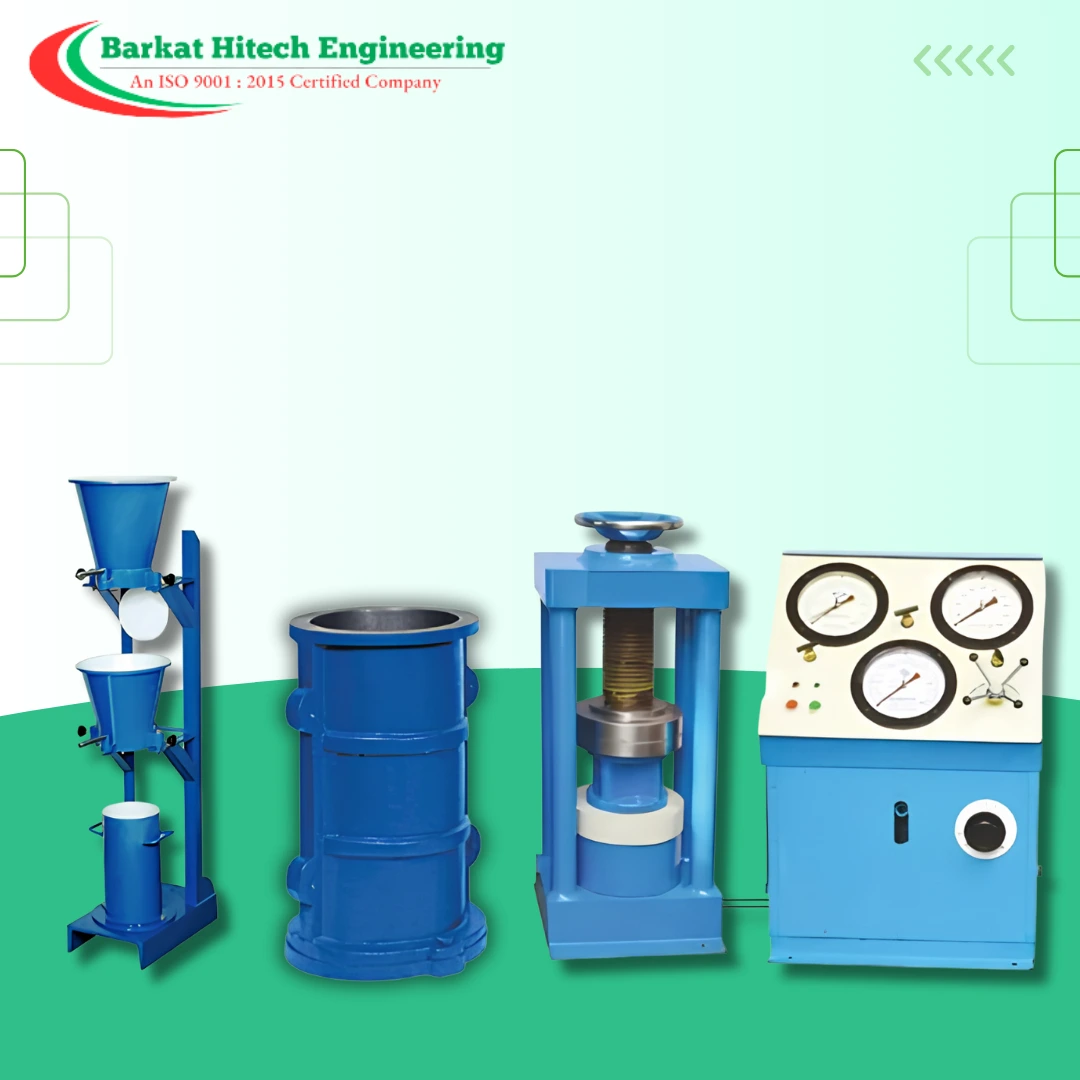
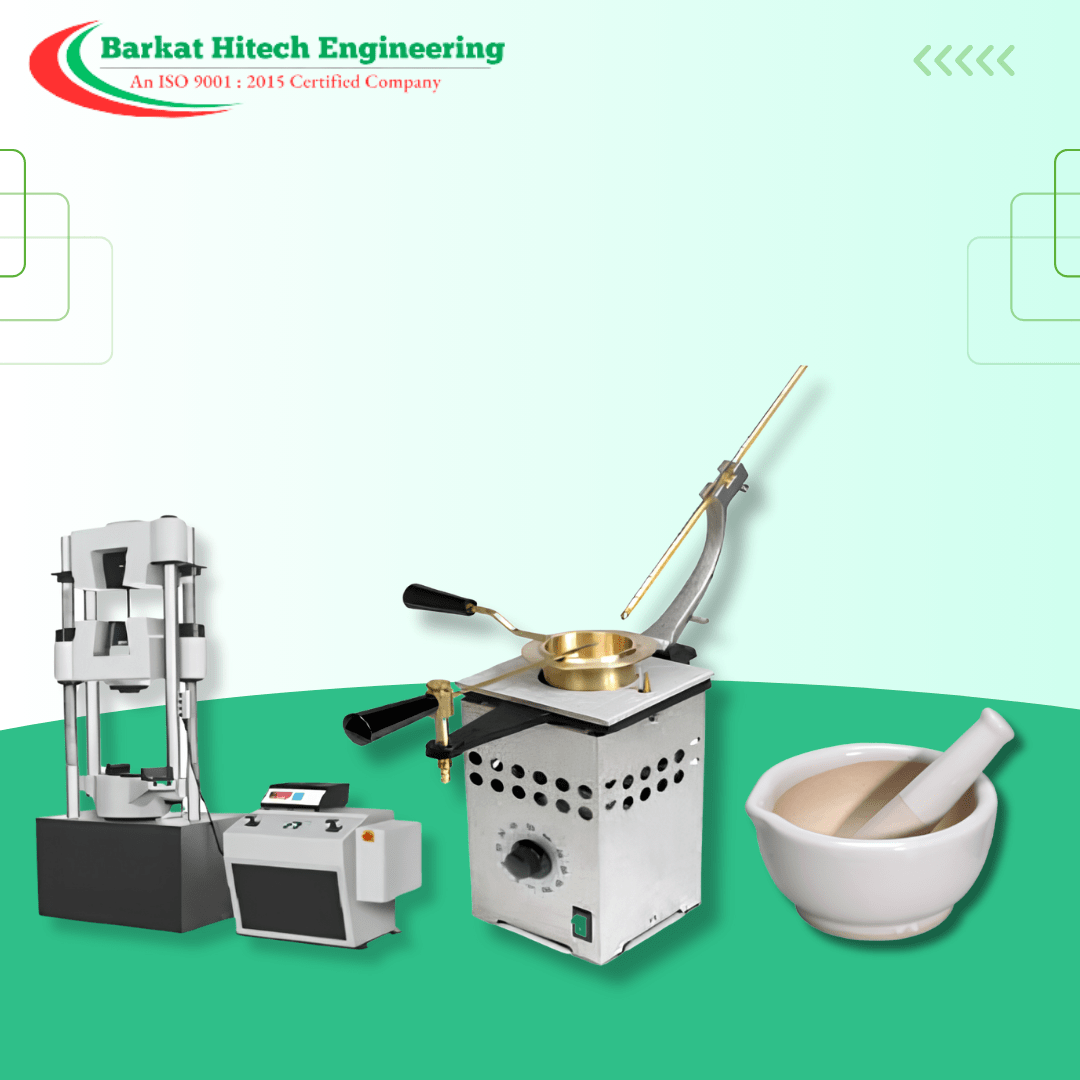
A Compression Testing Machine (CTM) by Barkat Hitech Engineering is a specialized testing device used to determine the compressive strength of concrete cubes, cylinders, blocks, and other construction materials.
The machine applies a gradually increasing compressive load to a concrete specimen until failure occurs. The maximum load sustained by the specimen is recorded and used to calculate its compressive strength.
Compression Testing Machines are commonly used in:
- Construction laboratories
- Ready-mix concrete plants
- Research institutions
- Infrastructure projects
- Quality control facilities
- Educational institutions
As a key component of Concrete Testing Equipment from Barkat Hitech Engineering, CTMs provide valuable insights into the performance and reliability of concrete materials.
3. Importance of Compression Testing in Concrete Evaluation
3.1 Ensures Structural Safety
The primary purpose of compression testing is to verify that concrete can safely withstand the loads it will experience during its service life.
Testing helps engineers confirm that:
- Concrete meets design specifications
- Structures comply with safety standards
- Construction quality remains consistent
3.2 Quality Control
Compression testing allows manufacturers and contractors to maintain consistent quality throughout the construction process.
Benefits include:
- Detection of weak concrete batches
- Verification of mix designs
- Improved production control
- Reduced risk of structural defects
3.3 Compliance with Standards
Many national and international standards require compressive strength testing before concrete can be approved for construction use.
Common standards include:
- ASTM Standards
- IS Standards
- BS Standards
- EN Standards
Reliable Concrete Testing Equipment by Barkat Hitech Engineering ensures compliance with these regulations.
3.4 Cost Savings
Identifying quality issues early prevents costly repairs, delays, and reconstruction efforts.
Compression testing helps:
- Minimize material waste
- Reduce project risks
- Improve resource utilization
4. Working Principle of a Compression Testing Machine
The Compression Testing Machine, Barkat Hitech Engineering, operates on a straightforward yet highly precise principle.
Step 1: Specimen Preparation
Concrete specimens are prepared according to standard dimensions, such as:
- Cubes (150 mm × 150 mm × 150 mm)
- Cylinders (150 mm × 300 mm)
These specimens are cured for a specified period.
Step 2: Placement
The specimen is placed centrally between the machine’s compression platens.
Step 3: Load Application
A controlled compressive load is applied gradually through hydraulic or electromechanical systems.
Step 4: Failure Observation
The load continues until the concrete specimen fractures or fails.
Step 5: Strength Calculation
The maximum load at failure is recorded and divided by the specimen area.
The compressive strength is calculated using:
fc=PAf_c=\frac{P}{A}fc=AP
Where:
- fc = Compressive strength
- P = Maximum load applied
- A = Cross-sectional area
The result indicates the concrete’s ability to resist compressive forces.
5. Components of a Compression Testing Machine
A modern Compression Testing Machine form Barkat Hitech Engineering consists of several important components.
5.1 Loading Frame
The loading frame provides structural support and withstands high compressive forces during testing.
5.2 Hydraulic System
Hydraulic pumps generate and control the testing load.
Features include:
- Smooth load application
- High accuracy
- Stable operation
5.3 Compression Platens
Platens transfer the load evenly onto the concrete specimen.
Proper alignment ensures accurate results.
5.4 Control Unit
The control system regulates testing speed and monitors load application.
Modern systems often include:
- Digital displays
- Touchscreen controls
- Automated testing sequences
5.5 Data Acquisition System
Advanced machines record:
- Peak load values
- Load rate
- Test duration
- Strength calculations
These systems improve traceability and reporting.
6. Types of Compression Testing Machines
6.1 Manual Compression Testing Machines
Manual machines require operator-controlled load application.
Advantages:
- Lower cost
- Simple operation
- Suitable for small laboratories
6.2 Semi-Automatic Compression Testing Machines
These machines automate certain testing functions while maintaining operator control.
Benefits:
- Improved accuracy
- Reduced operator dependency
- Faster testing
6.3 Fully Automatic Compression Testing Machines
Fully automated systems offer advanced features such as:
- Automatic loading
- Data recording
- Result analysis
- Report generation
These machines are ideal for high-volume testing facilities.
7. Applications of Compression Testing Machines
Compression Testing Machines have widespread applications across multiple industries.
7.1 Construction Industry
Used for:
- Building projects
- Commercial complexes
- Residential structures
- Industrial facilities
7.2 Infrastructure Development
Essential for testing materials used in:
- Bridges
- Dams
- Highways
- Airports
- Railways
7.3 Ready-Mix Concrete Plants
Helps verify concrete quality before delivery.
7.4 Research and Development
Used to study:
- New concrete formulations
- High-performance concrete
- Sustainable construction materials
7.5 Educational Institutions
Engineering colleges and universities use compression testing equipment for practical training and research.
8. Benefits of Using Advanced Concrete Testing Equipment
8.1 High Accuracy
Modern Testing Equipment, Barkat Hitech Engineering delivers precise and repeatable results.
8.2 Improved Productivity
Automated systems reduce testing time and increase laboratory efficiency.
8.3 Enhanced Safety
Built-in safety features protect operators during testing.
8.4 Regulatory Compliance
Ensures compliance with industry testing standards.
8.5 Better Decision-Making
Reliable test data helps engineers make informed construction decisions.
9. Standard Procedure for Concrete Compression Testing
Following a standardized testing procedure is essential for obtaining reliable results.
9.1 Sample Preparation
Concrete specimens are cast according to standard dimensions.
9.2 Curing
Samples are cured under controlled conditions for specified durations.
9.3 Surface Inspection
Specimens are checked for:
- Cracks
- Surface defects
- Dimensional accuracy
9.4 Machine Calibration
The Compression Testing Machine should be calibrated regularly.
9.5 Specimen Positioning
The sample is placed centrally on the lower platen.
9.6 Load Application
Load is applied continuously at a specified rate.
9.7 Failure Recording
The maximum load is recorded at specimen failure.
9.8 Strength Calculation
Compressive strength is calculated and documented.
10. Factors Affecting Concrete Compression Test Results
Several factors can influence test accuracy.
10.1 Improper Sample Preparation
Poor specimen casting can lead to inaccurate results.
10.2 Inadequate Curing
Insufficient curing reduces concrete strength.
10.3 Machine Calibration Errors
Uncalibrated equipment can produce misleading measurements.
10.4 Incorrect Load Application
Uneven or rapid loading affects accuracy.
10.5 Environmental Conditions
Temperature and humidity may impact concrete performance.
Using high-quality Concrete Testing Equipment minimizes these risks and improves reliability.
11. Features to Look for in Compression Testing Machines
When selecting a Compression Testing Machine, consider the following features.
11.1 Load Capacity
Choose a machine suitable for your testing requirements.
Common capacities include:
- 1000 kN
- 1500 kN
- 2000 kN
- 3000 kN
11.2 Digital Display
Provides real-time monitoring of test parameters.
11.3 Automation
Automated systems improve consistency and efficiency.
11.4 Data Storage
Allows easy retrieval of test records.
11.5 Software Integration
Advanced software enables:
- Data analysis
- Report generation
- Quality management
11.6 Safety Features
Look for:
- Emergency stop buttons
- Overload protection
- Safety shields
12. Why Choose a Trusted Concrete Testing Instrument Manufacturer?
Selecting a reliable Concrete Testing Instrument Manufacturer, Barkat Hitech Engineering, is critical for achieving accurate and dependable testing results.
A reputable manufacturer provides:
12.1 High-Quality Equipment
Precision-engineered machines ensure reliable performance.
12.2 Compliance with Standards
Equipment meets international testing requirements.
12.3 Technical Support
Professional assistance helps maintain equipment performance.
12.4 Calibration Services
Regular calibration ensures testing accuracy.
12.5 Custom Solutions
Manufacturers can provide equipment tailored to specific laboratory needs.
12.6 Long-Term Reliability
Durable construction reduces maintenance costs and downtime.
Investing in equipment from an experienced manufacturer improves operational efficiency and testing confidence.
13. Future Trends in Concrete Testing Equipment
Technological advancements continue to transform the construction testing industry.
Emerging trends include:
13.1 Smart Testing Systems
Integration of sensors and IoT technology enables real-time monitoring.
13.2 Cloud-Based Data Management
Test results can be stored and accessed remotely.
13.3 Artificial Intelligence
AI-powered systems can analyze test data and identify patterns.
13.4 Fully Automated Laboratories
Automation reduces human intervention and improves consistency.
13.5 Sustainability Testing
New equipment supports the testing of eco-friendly and low-carbon concrete materials.
These innovations are enhancing the effectiveness of modern Concrete Testing Equipment from Barkat Hitech Engineering and helping construction professionals achieve higher quality standards.
Conclusion
Concrete strength evaluation is a fundamental aspect of construction quality assurance, and the Compression Testing Machine remains one of the most important tools for this purpose. By accurately measuring compressive strength, these machines help ensure structural safety, regulatory compliance, and long-term durability.
As construction projects become increasingly complex, the demand for advanced Concrete Testing Equipment continues to grow. Modern Compression Testing Machines provide superior accuracy, automation, and efficiency, enabling engineers and laboratories to maintain high-quality standards throughout the construction process.
Partnering with a trusted Concrete Testing Instrument Manufacturer is Barkat Hitech Engineering, ensures access to reliable equipment, expert support, and innovative testing solutions. Whether for infrastructure projects, quality control laboratories, research facilities, or educational institutions, investing in high-quality compression testing equipment is essential for achieving dependable concrete strength evaluation and successful project outcomes.
FAQs
1. What is a Compression Testing Machine?
A Compression Testing Machine is used to measure the compressive strength of concrete specimens.
2. Why is concrete compression testing important?
It verifies that concrete can safely withstand the loads specified in a construction project.
3. What types of specimens are tested in a CTM?
Concrete cubes, cylinders, and blocks are commonly tested.
4. Which standards govern concrete compression testing?
Common standards include IS 516, ASTM C39, BS standards, and EN standards.
5. How does a Compression Testing Machine work?
It applies increasing compressive force until the concrete specimen fails and records the maximum load.
6. Who uses Concrete Testing Equipment?
Construction companies, laboratories, engineers, contractors, and research institutions use it.
7. How often should a CTM be calibrated?
Calibration should be performed regularly according to industry standards and manufacturer recommendations.
8. Why choose Barkat Hitech Engineering?
Barkat Hitech Engineering offers accurate, durable, and standards-compliant Concrete Testing Equipment backed by expert support.